Chapter 3
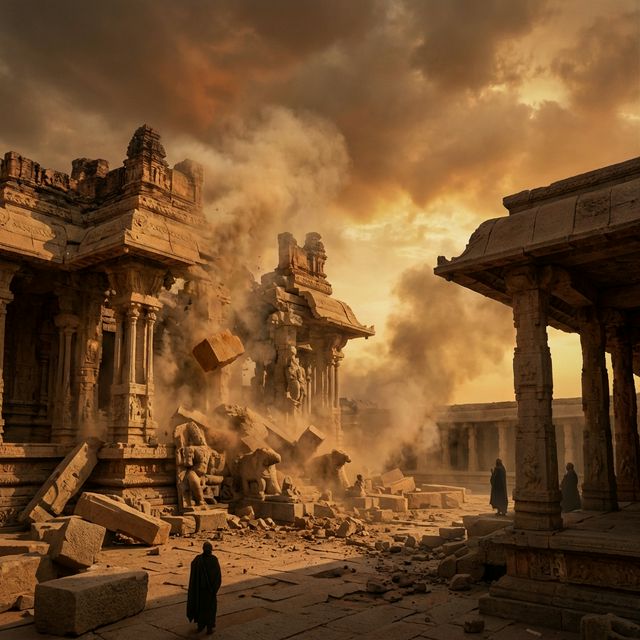
Temple Destructions
A comprehensive account of sacred Hindu temples destroyed or desecrated by Sikandar Lodi, documented through archaeological surveys, primary chronicles, and historical records.
A comprehensive account of sacred Hindu temples destroyed or desecrated by Sikandar Lodi, documented through archaeological surveys, primary chronicles, and historical records.
Sikandar Lodi's campaign of temple destruction was not random violence. It was a systematic, state-sponsored program to erase Hindu sacred geography across northern India. His epithet — "But-Shikan" (Destroyer of Idols) — was not a criticism but a badge of honor, documented by his own court historians.
The temples he targeted were not merely places of worship. They were centers of learning, art, music, and community life. Their destruction represented the erasure of centuries of accumulated knowledge, artistic achievement, and cultural memory.
Each entry documents a temple or sacred site destroyed during Sikandar Lodi's reign, with historical sources and current status.
The most sacred site associated with the birth of Lord Krishna. An ancient temple that had been rebuilt multiple times after previous destructions. Sikandar Lodi ordered its complete destruction c. 1490 CE.
The site remains contested. A mosque (Shahi Idgah) stands adjacent to the reconstructed temple. Legal proceedings for reclamation are ongoing in Indian courts as of 2024.
Tarikh-i-Daudi by Abdullah; ASI Report "A Tour in Eastern Rajputana" by Alexander Cunningham (1882-83); Tarikh-i-Ferishta by Muhammad Qasim Ferishta
One of the most important Shiva temples in Hinduism, associated with one of the twelve Jyotirlingas. Sikandar Lodi attempted to destroy this temple during his reign.
While the full extent of damage during Sikandar Lodi's specific campaign is debated, multiple sources confirm that he attempted to attack this temple. The Kashi Vishwanath temple has been destroyed and rebuilt multiple times throughout history — by various Islamic rulers including Qutb-ud-din Aibak, Aurangzeb, and others.
The current temple was rebuilt in 1780 by Ahilyabai Holkar. The adjacent Gyanvapi Mosque, built by Aurangzeb after 1669 destruction, is subject to ongoing legal proceedings.
Referenced in Tarikh-i-Daudi; Historical analysis citing primary sources
After capturing the fortress of Mandrail, Sikandar Lodi ordered the destruction of Hindu temples within and around the fortress complex. The temples were replaced with mosques.
The capture of Mandrail was part of Sikandar Lodi's military campaigns to expand his territory. The temple destruction was not a byproduct of warfare but a deliberate post-conquest policy — temples were destroyed only after the fort was already secured.
Tarikh-i-Daudi; Tarikh-i-Ferishta
Hindu temples at Utgir were demolished under Sikandar Lodi's orders. The destruction followed the same pattern: temples were razed and mosques constructed in their place.
The targeting of Utgir demonstrates the geographical range of Sikandar Lodi's anti-Hindu campaign — it was not limited to the Delhi region but extended across his domain into central India.
Tarikh-i-Daudi; Referenced in historical analyses of temple destructions
The temples at Narwar (modern-day Shivpuri district, Madhya Pradesh) were destroyed following Sikandar Lodi's conquest of the region. The ancient Narwar Fort, with its Hindu temple complexes, faced systematic destruction.
Each conquest followed the same pattern: military victory → temple destruction → mosque construction → prohibition of Hindu worship. This was not incidental warfare damage — it was deliberate religious cleansing.
Tarikh-i-Daudi; Historical records of Narwar Fort
The famous Hindu temples at Nagarkot (present-day Kangra region) — including ancient temple complexes associated with the Jwalamukhi tradition — were targeted by Sikandar Lodi. He ordered their destruction and forbade the construction of new Hindu temples throughout his domain.
Nagarkot was in the hills, far from the Delhi power center. The targeting of these remote temples demonstrates that the campaign was religiously motivated rather than politically necessary — there was no strategic benefit to destroying temples in the distant hills.
Tarikh-i-Daudi; Testbook.com historical references; Referenced in multiple analyses
Sikandar Lodi's temple destruction followed a documented, repeatable pattern — a systematic approach that went beyond mere destruction to calculated humiliation and permanent erasure:
The target city or fortress is conquered through military force. Temples survive the initial battle — destruction comes afterwards as a deliberate policy.
Hindu temples are demolished by direct order. The structures are razed to the ground. In Mathura, the Tarikh-i-Daudi records that he "utterly destroyed diverse places of worship of the infidels, and left not a vestige remaining of them."
Idols and sacred sculptures are not merely destroyed but deliberately desecrated. In Mathura, stone images of Hindu deities were given to butchers to use as meat-weights — an act designed to cause maximum spiritual and psychological pain to the Hindu community.
Mosques, madrasas, caravanserais, and bazaars are constructed atop the ruins of destroyed temples or opposite them — making the triumph permanent and visible.
Hindu religious practices at and around the sites are banned — bathing in sacred rivers, traditional rituals, religious processions. The spiritual life of the community is suppressed alongside the physical destruction.
Jizya and pilgrim taxes are imposed, making Hindus pay for the privilege of their faith even as their sacred sites are destroyed. This creates ongoing economic suffering layered atop spiritual devastation.
Some historians attempt to frame temple destructions as byproducts of warfare — incidental damage in military campaigns. The evidence contradicts this: temples were destroyed after military victory, as a calculated post-conquest policy. The taking of idols given to specific groups (butchers), the construction of alternative structures on temple sites, and the imposition of religious bans demonstrate deliberate, premeditated religious persecution.
The temples destroyed by Sikandar Lodi were not just buildings. They were nodes in India's sacred geography — pilgrimage sites, centers of learning, repositories of art and sculpture, and community gathering places that had served their communities for centuries.
The destruction of the Krishna Janmasthan at Mathura, for example, was an attack on one of the seven sacred cities (Sapta Puri) of Hinduism. Mathura was not just a city with a temple — it was the birthplace of Lord Krishna, central to the faith of hundreds of millions.
Similarly, the attempted destruction of Kashi Vishwanath — one of the twelve Jyotirlingas — was an assault on the very theological geography of Shaivism.
These were strategic attacks on the most significant sites of Hindu civilization, chosen for their religious importance specifically to maximize psychological and spiritual devastation.