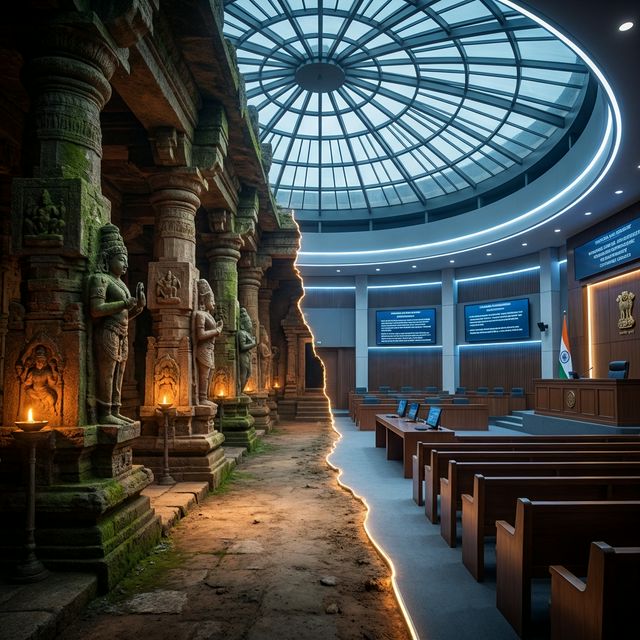
Chapter 7
Legacy & Modern Impact
Five centuries later, the wounds of Sikandar Lodi's reign remain open. This is not ancient history — it is the prologue to today's struggles.
Five centuries later, the wounds of Sikandar Lodi's reign remain open. This is not ancient history — it is the prologue to today's struggles.
The most immediate and visible legacy of Sikandar Lodi's destruction is the current state of the temple sites he attacked. Five centuries later, several of these sites remain contested — physical evidence of historical wounds that have never been allowed to heal.
The site where Sikandar Lodi destroyed the ancient Krishna Janmasthan temple (c. 1490 CE) is today one of India's most contested religious sites. The Shahi Idgah mosque stands adjacent to the reconstructed Krishna Janmasthan temple — itself rebuilt only to the side of the original location, not on it.
Legal status (as of 2024-25): Multiple lawsuits have been filed in Indian courts seeking the removal of the Shahi Idgah mosque and the restoration of the full temple complex. The Allahabad High Court has accepted petitions, and the matter is under judicial consideration. This legal battle is a direct continuation of the historical event — the injury inflicted by Sikandar Lodi in 1490 is still being adjudicated in 2025.
While the Kashi Vishwanath temple was ultimately destroyed later by Aurangzeb (1669), Sikandar Lodi's attempted destruction was an early chapter in the ongoing saga. The Gyanvapi case — India's most prominent ongoing temple-mosque legal dispute — has its roots in the same pattern of destruction that Sikandar Lodi helped establish.
The 2022 ASI survey of the Gyanvapi site confirmed the presence of Hindu temple remains beneath the mosque, validating the historical accounts of destruction that extend back to rulers including Sikandar Lodi.
The city of Mathura today is a living testament to the layered destruction of its heritage. The areas where Sikandar Lodi ordered bazaars and caravanserais to replace temple structures continue to bear the scars of that transformation. Archaeological evidence of the original temple complex occasionally surfaces during construction and excavation, serving as physical reminders of what was lost.
Some of the damage inflicted during Sikandar Lodi's reign — and the broader Sultanate/Mughal period — is irreversible. Certain cultural practices, art forms, and knowledge traditions were so thoroughly disrupted that they could not be reconstituted:
The specific stone-carving traditions of the late medieval period in the Delhi Sultanate's territories were irreparably damaged. While sculpture continued in southern India and in Rajput kingdoms, the specific regional styles of the areas under Lodi control were lost. The deliberate act of giving idols to butchers as meat-weights sent a message that Hindu sculptural art was literally worth less than animal flesh, discouraging entire communities of artisans from continuing their craft.
While Indian classical music survived and evolved, certain temple-specific musical traditions tied to destroyed temple complexes were lost. Each temple had its own traditions of devotional music — specific compositions, specific performance styles — that existed nowhere else. When the temples were destroyed, these unique traditions died with them.
The manuscripts destroyed in temple libraries represent an incalculable loss. Sanskrit literary tradition was vast — spanning poetry, drama, philosophy, science, medicine, astronomy, and linguistics. Much of this was transmitted through handwritten manuscripts maintained in temple and scholarly collections. We will never know the full extent of what was lost because the records of what existed were destroyed along with the works themselves.
The ongoing legal battles for sites like the Krishna Janmasthan at Mathura are directly connected to Sikandar Lodi's destruction. These are not abstract historical disputes — they involve living communities seeking the return of their holiest sites, taken from them by documented acts of religious persecution. Understanding this history is essential for informed participation in these civic and legal debates.
The systematic omission of documented atrocities from educational materials is itself a continuing harm. When textbooks present Sikandar Lodi as merely a "patron of arts" while omitting his documented destruction and persecution, they deny Indian students the right to their own history. Historical literacy requires confronting uncomfortable truths.
For hundreds of millions of Hindus, the temples destroyed by Sikandar Lodi and other medieval rulers are not mere archaeological curiosities — they are sacred sites tied to living religious traditions. The Krishna Janmasthan is not a "former temple" — it is the birthplace of Lord Krishna, sacred to over a billion people today. Understanding the history of its destruction helps contextualize the depth of feeling around these sites.
Globally, societies have increasingly recognized the importance of acknowledging historical wrongs. From the acknowledgment of colonial-era injustices by European nations to the recognition of indigenous land rights in the Americas and Australasia, the pattern of "truth and reconciliation" begins with honest historical acknowledgment. India's medieval-era religious persecution deserves the same honest reckoning.
The famous dictum that "those who do not learn from history are condemned to repeat it" applies with particular force to religious persecution. Understanding the mechanisms of Sikandar Lodi's persecution — how state power was used to destroy religious liberty — provides essential lessons for protecting religious freedom in the present and future.
This website documents one chapter in a much larger story — the story of Indian civilization's encounter with waves of destruction, and its remarkable capacity for resilience and renewal.
Sikandar Lodi destroyed temples. Hindus rebuilt them — sometimes centuries later. He banned rituals. Communities preserved them in private. He burned libraries. Scholars memorized texts and carried them to safety. He executed a Brahmin for his beliefs. Those beliefs survived and thrived.
The story of Sikandar Lodi is a story of destruction. But the larger story of Indian civilization is a story of survival against extraordinary odds. Understanding the destruction is essential to appreciating the survival.