Chapter 5
Cultural Destruction
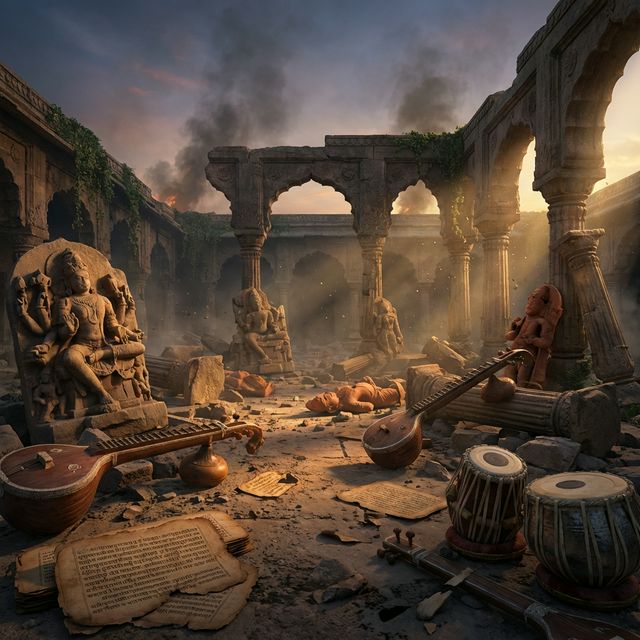
Beyond temples — how Sikandar Lodi's policies systematically dismantled centuries of Indian art, learning, music, dance, scholarship, and cultural heritage.
Beyond temples — how Sikandar Lodi's policies systematically dismantled centuries of Indian art, learning, music, dance, scholarship, and cultural heritage.
To understand the true cultural devastation of Sikandar Lodi's temple destruction campaign, one must first understand what Indian temples actually were. They were not merely places of prayer — they were the primary institutions of Indian civilization, serving multiple critical functions:
Hindu temples housed pathshalas (schools) and gurukuls (residential schools) where Sanskrit grammar, mathematics, astronomy, philosophy, medicine, and other sciences were taught. The destruction of a temple meant the destruction of its educational infrastructure — students displaced, libraries lost, teaching lineages broken.
Temples maintained collections of manuscripts, scrolls, and scholarly works accumulated over centuries. These were not mere copies — many were unique documents representing the only surviving records of specific texts, commentaries, and scientific works. When a temple was destroyed, its library was lost forever.
The intricate sculptures, murals, and carved panels adorning Hindu temples represented centuries of artistic evolution. Temple complexes were effectively living museums and working studios. The artists and sculptors who created these works passed down techniques through generations — when their patron temples were destroyed, these artistic lineages were severed.
Temple traditions of music (sangeet) and dance (nritya) were not casual performances — they were highly codified, complex art forms developed over millennia. Temples maintained dedicated performers and teachers. The destruction of temple infrastructure displaced these artists and broke the continuous chains of teaching that sustained classical Indian performing arts.
Many temple complexes included charitable services: annadanam (free food distribution), medical care using Ayurvedic traditions, shelters for travelers, and support for the destitute. The destruction of temples was simultaneously the destruction of the social welfare infrastructure of Hindu communities.
Temples were where communities gathered for festivals, celebrations, dispute resolution, and social bonding. They were the center of community identity. Their destruction fragmented communities and erased their focal points of shared cultural life.
One of the most significant but least discussed impacts of Sikandar Lodi's reign was the destruction of Sanskrit learning infrastructure. By the time of the Lodi dynasty, Sanskrit was not just a language of religion — it was the medium of science, philosophy, mathematics, medicine, astronomy, and literature for an entire civilization.
Textbooks praise Sikandar Lodi for commissioning the Tibb-i-Sikandari — a translation of an ancient Indian medical treatise from Sanskrit into Persian. But consider the full picture: he was translating Sanskrit medical knowledge while simultaneously destroying the institutions that produced that knowledge. He appropriated the intellectual output of a civilization while systematically dismantling the civilization itself. This is not "patronage of learning" — it is intellectual colonialism.
Beyond the physical destruction of institutions, Sikandar Lodi's policies attacked the living practices that constituted Hindu cultural life:
The ban on Hindu bathing at the Yamuna in Mathura was not just a restriction on a physical activity. Sacred bathing (snan) is a fundamental Hindu practice tied to purification, prayer, and connecting with the divine. Banning it at Mathura — one of the holiest pilgrimage sites — was an attack on the very concept of tirtha (sacred crossing places) that forms the foundation of Hindu sacred geography.
The prohibition on head-shaving struck at fundamental Hindu samskaras (life-cycle ceremonies). Head-shaving is integral to:
By banning this single practice, Sikandar Lodi struck at the entire lifecycle framework of Hindu society.
Hindu festivals are characterized by vibrant public processions — rath yatras, palkhi processions, and community celebrations that fill streets with music, dance, and worship. Banning these processions meant that Hindu faith was confined to private spaces, made invisible in the public sphere. This was cultural erasure through forced privatization of identity.
India's artistic traditions — sculpture, painting, music, dance — were institutionally rooted in temple patronage. Sikandar Lodi's destruction of this patronage system had cascading effects:
The destruction of temples meant the destruction of the demand for stone sculpture and architectural art. With no temples to build or adorn, sculptors and architects lost their livelihood. The act of giving sacred stone images to butchers as meat-weights was a deliberate message: your art is worthless.
Temple dance traditions (devadasi traditions, precursors to classical forms like Bharatanatyam and Odissi) depended on temple patronage for survival. As temples were destroyed, these dance lineages lost their institutional homes and many were disrupted or destroyed.
Hindu devotional music traditions — bhajan, kirtan, and classical raga systems — were deeply intertwined with temple worship. The suppression of Hindu religious practices inevitably suppressed the musical traditions attached to them.
Textbooks celebrate the compilation of Lahjat-i-Sikandar Shahi, a book on Indian musical compositions, during his reign. But again, this was documentation of traditions he was simultaneously destroying. Recording music while destroying the institutions and communities that created it is not cultural patronage — it is the behavior of a collector taking trophies from a civilization he is dismantling.
The documented destruction and persecution created waves of displacement — scholars, artists, priests, and entire communities were forced to flee:
This "brain drain" of Hindu intellectual and artistic talent from the Sultanate's territories represented a permanent cultural impoverishment that cannot be calculated in numbers alone.